Posts

Ahmadinejad and half trillion USD oil income

Image
With the passing of 15 months from Iran's former Mine and Industry Minister Eshagh Jahangiri's statement about Ahmadinejad administration's $450 billion oil crude revenues until March 2011, former deputy of Iran's oil minister Akbar Torkan updated the figure on Aug.4, saying Iran's oil revenues during Ahmadinejad's seven-year long two terms of the presidency (from June 2005 till now) has totalled to $531 billion. It is now 103 years after the first crude oil production from Iran's Masjed Soleyman oilfield, a project which became operational after seven years of excavation starting in 1901. Mehr News Agency quoted Torkan as saying the country's total oil incomes since 1908 have amounted at $1116 billion, including $140 billion until the Islamic revolution occurred in 1979 and $976 billion afterwards. Iran's crude stats during Ahmadinejad's presidency published by OPEC Iran oil revenues/ billion USD oil output/ mbpd Oil export/ mbp...

Iran’s LNG dreams relying on China

Image
China's 3.3 billion worth LNG refining facility construction contract with Iran was suspended last day. It was Iran's sixth suspended LNG project and aimed at producing 10.5 million tons of LNG per year. Iran says the major problem is the lack of finance power of the Chinese consortium which media outlets previously identified it as Chinese SINOC group. In the fourth 5-Year National Develop Plan (2005-2009), the country aimed to produce 70 million tons of liquefied natural gas (LNG) from the South Pars, North Pars, Ferdosi and Golshan gas fields by launching six LNG production facilities. After cancelling Iran's LNG project contracts with French Total, Spanish Repsul, Dutch-British Shell and Malaysian Petronas until 2008, Iran practically lost as much as 27 million tons of its LNG production capacity. After that in 2008, Iran signed $25 billion worth of contracts to develop its gas fields and produce LNG with the Chinese SINOC group, Chinese CEPA, Polish state...

Iran’s wheat problem has become complicated

Image
Iranian outlets are increasingly warning about a wheat shortage in the country which stands beside the world's biggest cereal importers with an annual corn purchase of more than seven million tons. Iranian semi-official Fars News Agency reported on July 22 that Indian flour cargoes have been distributed among Tehran's bakeries while according to agreements between Iran and India, New Delhi's wheat should have been imported to Iran, not its flour. The agency added that Iranian flour mill factories are working at 50 per cent capacity. Iran and India agreed that 45 per cent of Iranian oil export payment be paid off through rupees used for purchasing Indian goods by Iranian businessmen, including rice, tea and wheat. On the other hand, Iranian Mehr News Agency reported that interior wheat producers should sell their harvest to private sector that pays more for the wheat than the government and sell to poultry and livestock firms. Reportedly, Iranian Qom city's ...

Iran leaps from 3.5-percent to weapon-grade refined uranium

Image
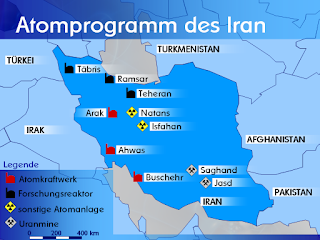
Iranian parliament member, close to ruling conservatives party, Allah-Verdi Dehghani's statement about the necessity of producing nuclear-fuel engines for ships because of avoidance of the U.S. allies to provide Iranian ships with fossil type fuel, are likely to increase the doubts over the final goal of Iran's nuclear program. Earlier, in 2010, Iran started processing 20-percent enriched uranium due to avoidance of western countries from bartering 1,200 kg of Iran's 3.5-percent enriched uranium gas (UF6) stockpile with 120 kg of 20-percent enriched nuclear fuel for 5 megawatt-thermal Tehran's Research Reactor (TRR). Now, according to International Atomic Energy Agency's (IAEA) latest report, Iran holds above 140 kg 20-percent enriched uranium, without existence of another pool-type reactor in the country, excepting TTR. During an interview with Iranian Mashreghnews.ir website, Dehghan said that Iran should produce higher-level uranium for ships. However,...

Iran’s private sector and hopes to circumvent oil sanctions

Image
Iran says a consortium of Iran's private sector companies will take on 20 percent of the country's total crude oil exports as international sanctions against the Iran's oil and banking sectors took effect on July 1. According to Mehr report, Oil Ministry and Central Bank have agreed to transfer the exports of some 500,000 barrels of crude oil (about 20 percent of Iran' total oil export) to the private sector as a way to circumvent the sanctions. With regarding this fact that Iran's private sector has never sold any oil, yet, then it's unclear that how can they succeed in organizing oil export, to ship, to get insurance and re-insurance, to get the money and the mechanism of transferring that to inside country. On the other hand, Iran has started offering oil in Kish Exchange since last year, but after 8 times failed attempts to sell crude oil, it withdrew from this plan. Hassan Khosrojerdi, the head of the Iranian Oil, Gas and Petrochemical Produc...

Iran likely give up SP oil layer to Qatar

Image
The oil inspection affairs department of the General Inspection Organization of Iran has reported that Iran is currently extracting less than 35,000 barrels of crude oil from the South Pars gas field's oil layer, while the Qatari side is exploiting as much as 450,000 barrels per day. The South Pars gas field is associated between Iran and Qatar. It holds around 30 trillion cubic meters of natural gas. It has an oil layer with an estimated reserve of 1.6 billion barrels with 30.3 deg. API with 1.9 percent sulphur. According to studies in 2005, the oil layer is divided into two sections, but the National Iranian Oil Company's exploration department rejected the theory in 2010 using existing geophysical surveys. The oil layer is jointly owned by Iran and Qatar. The 13-fold exploitation of Qatar compared to Iran from the oil layer means that reserves in the Iranian side will be flowing down into the southern section in Qatar in the long run. Maersk Oil Qatar AS Compa...

NPT’s Article IV and Iran’s nuclear proposal

Image
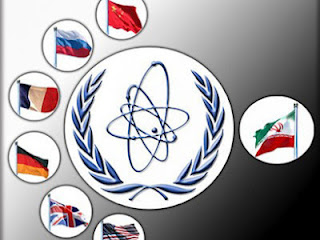
Iranian president told Frankfurter Allgemeine newspaper on eve of new nuclear talks that Iran can halt 20 per cent-enriched uranium process if the West countries guarantee to supply all needed nuclear fuels for Iranian nuclear power plants. On the other hand, Iranian Parliament Speaker Ali Larijani announced last week that Iran can decide for itself to what degree it wants to enrich uranium based on "domestic demands". He spoke on the eve of nuclear talks between Iran and the worlds' six major powers in Moscow. Iran and P5+1 negotiated the nuclear issue in Russia on Monday without result and want to keep talks going onTuesday. It seems Iran is preparing to compromise towards the West, but the coincidental issue is Iran's demand that its uranium enrichment rights be respected and accepted by the international community, as Ali Bagheri, deputy of Iran top nuclear negotiator suggested. Iran's demand is a disputed point because the UN Security Council has...