Posts

Iran’s electricity down despite output capacity growth

Iran’s domestic electricity sales decreased by more than 21 terawatt-hours (TWh) to 206.3 TWh during the last fiscal year, according to Energy Ministry. The statistics of the annual report, released on the Ministry’s website indicate that the country increased the power generation capacity by about 2.64 GW, but the actual gross electricity generation decreased by 5.218 TWh during the last fiscal year, compared to the same period of the previous year. Iran’s fiscal year started on March 21. Electricity consumption Last fiscal year TWh Y/Y change TWh Share of total consumption Number of consumers (1000) Housing sector 70.587 -5.516 34.2% 27,220 Public sector 19.587 -2.609 9.5% 1,570 Industrial sector 64.535 -7.692 31.3% 222 Agriculture sector 32.712 -3.377 15.9% 396 Commercial sector 15.047 -1.633 7.2% 4,280 Street light 3.839 -0.178 1.1% - Total 206.308 -21.003 100 - The country increase...
Iran sells 2.6 mb/d oil, plans to export same volume

Iran exported 2.6 million barrels of crude oil and gas condensate per day during the last fiscal year (ended March 20), of which 2 mb/d was crude oil, said Iran’s oil minister Bijan Namdar Zanganeh. Zanganeh said that during the sanctions era (2012-2015), about 70 million barrels of unsold gas condensate stockpile was stored on tankers, but after the removal of sanctions in January 2016, the volume was sold gradually and reached about zero by March 20, 2017, IRNA reported. Therefore, Iran had sold 2.6 mb/d of newly produced oil and gas condensate and sold 200,000 b/d from its gas condensate stockpile on water during last year. During the sanctions era, Iran’s oil (including gas condensate) output and export volume decreased from 4.1 mb/d and 2.5 mb/d to 3.3 mb/d and 1.2 mb/d respectively. Zanganeh said that Iran plans to keep the export volume unchanged during the current fiscal year. However, he has announced a week earlier that Iran plans to export 2.4 mb/d of oil and gas condensate...

Iran’s power sector dramatically ups gas usage

Image
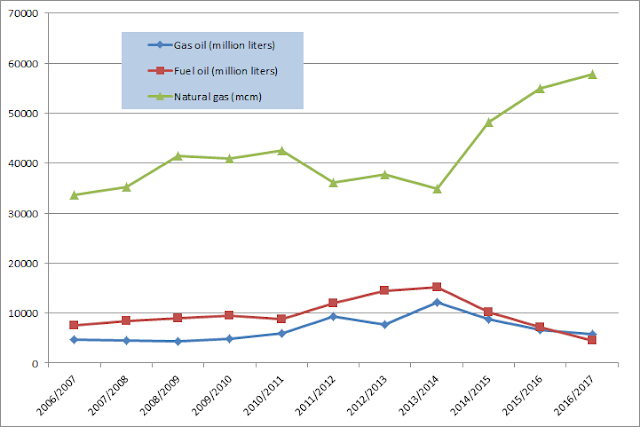
Iran increased gas deliveries to power plants by 4.7 percent to 57.74 billion cubic meters (bcm) during last fiscal year (ended Mar. 20, 2016), while the plan was a 20 percent growth to 65 bcm. However, the statistics of Energy Ministry indicate a huge growth in replacing liquid fuels with gas in power generation sector during last four years. Iran had planned to deliver 65 bcm of gas to power sector during last year, and increased the growth by 8.5 percent until the end of fall, 2016, but it seems Turkmenistan’s cutting its gas export to Iran during winter caused a decrease in gas deliveries to power sector. Turkmenistan exported 9 bcm of gas to Iran in 2015, but it cut gas deliveries in January 1, 2017 due to Iran’s $2 billion debt to Ashgabat. However, weekly statistics of Iran’s Energy Ministry indicate that the gas flow to power plants during 11 days of current fiscal year (March 21-March 31) experienced a 14.13 percent growth to 1.411 bcm. Iran’s gas deliveries to p...

Iran predicts less oil export than before sanctions

While Iran’s oil and gas condensate export reached 3.05 million barrels per day (mb/d) in the 12th month of the last Iranian fiscal year (Feb.22 to Mar.21), the country eyes the the export volume for the current fiscal year to be at 2.4 mb/d in average. This would be less than 2.5 mb/d of pre-sanctions level. Iran was exporting 2.2 mb/d of crude oil as well as 300,000 b/d of gas condensate in 2011, but after the sanctions, Iran’s total oil and gas export decreased to 1.2 mb/d. After the removal of sanctions in January 2016, Iran increased the oil export gradually, up to about 3 mb/d in March, thanking to selling tens of million barrels of stored oil on water, according the Oil Ministry’s announcement. Iran's Oil Minister Bijan Namdar Zanganeh said on Apr.5 that for the current fiscal year, started on March 21, Iran plans to export 2.4 m/b of crude oil and gas condensate together, IRNA reported. It seems, a part of Iran’s oil export growth during last months has relied on selling...

Idle capacity of Iran’s petchem plants increases

Despite Iran’s growing petrochemical production level, the idle capacity of plants increased significantly. According to an official report prepared by National Petrochemical Company and seen by Trend, about 25 percent of Iran’s nominal petrochemical production capacity was idle during 11 months of last fiscal year (ended March 20). During the previous fiscal year (2015/2016), the figure was 20 percent. The country added about 4.3 million tons per year (mn t/y) to its nominal petrochemical production capacity during 11 months of last fiscal year. Iran’s petrochemicals output 11 months of last fiscal year (2016/2017) 12 months of the previous fiscal year (2015/2016) Nominal capacity (mn t) 62.2 57.9 Projected production (mn t) 52.945 49.365 Actual production (mn t) 46.17 46.41 Idle capacity 25% 20% Share of feedstock shortage in idle capacity 47.9% 44.8% Source: National Petrochemical Company The statistics indicate that the share...

End of Iran’s fiscal year: gas output at 820 mcm/d

Image
Iran’s fiscal year would end on March 20, and the latest statistics indicate that the country has increased its gas output capacity by about 70 mcm/d during the current fiscal year. The country’s gas output growth came from the South Pars gas field, joint with Qatar. Iran’s side contains about 14 trillion cubic meters of gas and 18 billion barrels of gas condensate. Before Hassan Rouhani’s administration (mid-2013), Iran’s total gross gas output (including re-injection and flaring) was about 600 mcm/d, of which South Pars’ share was 40 percent. Before mid-2013, only ten phases of the field had been commenced with 240 mcm/d of gross gas output. Currently, the volume stands at about 469 mcm/d. During Rouhani’s administration about 8 new phases of South Pars became full of half operational and the output of phases 1-10 increased. South Pars Current output (mcm/d) Final capacity (mcm/d) Phases 1-10 270 270 ...

Iran may become net energy importer by 2025

Image
With the current pace of Iran’s energy consumption growth, the country may become a net energy importer by 2025, Farzad Kiyasat, a member of Iran’s Energy Conservation Society, said Mar. 13. He added that Iran, with a population of 80 million, consumes energy like a country with an 800-million population, and each 4 years Iran’s energy usage doubles, Fars reported. According to him, the energy intensity index of Iran is very high. Currently, Iran daily produces 4.2 million barrels (mb/d) of oil and gas condensate, while the figure is expected to reach 5.4 mb/d by 2020. Iran’s gross gas production stands at about 280 billion cubic meters per year (bcm/y), which is expected to be around 450 bcm/y in five years. However, the official statistics of last decades indicate that the country’s energy consumption increased significantly, very faster than population and GDP growth. Iran’s primary energy consumption. Source: Oil Ministry’s statistics The statistics indicate that the...